

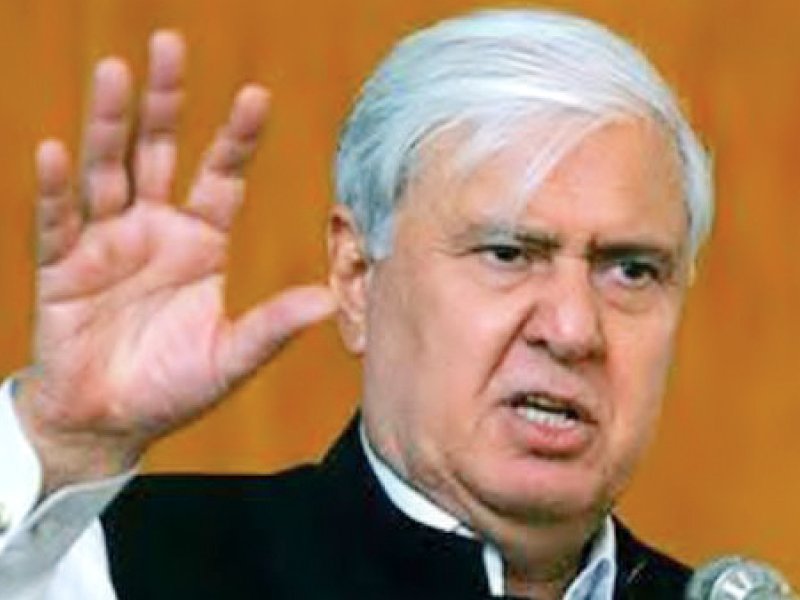
- By: Barrister Usman Ali, Ph.D.
In the ever-shifting landscape of Khyber Pakhtunkhwa’s politics, where promises of change, progressive ideals, and religious narratives have often swayed the masses, true leadership has remained a rare constant. Aftab Ahmad Khan Sherpao stands as one of the few figures who have not only weathered these tides but also shaped the province’s political direction with resilience, pragmatism, and an unyielding connection to the people.
Pashtun politics has often fallen victim to empty slogans and fleeting popularity. At times, the people have been pushed in different directions, sometimes in the name of religion, sometimes in the name of progressive ideologies, and sometimes under the slogan of “change.” This approach has made it difficult to recognize true leaders and maintain consistent leadership. However, Khyber Pakhtunkhwa has produced many prominent political leaders who have played vital roles in national politics. The founder of the Khudai Khidmatgar Movement, the proponent of nonviolence, and historic Pashtun nationalist leader Khan Abdul Ghaffar Khan, famously known as Bacha Khan, holds a unique and historic position.
Other influential late leaders include Khan Abdul Wali Khan, Maulana Mufti Mehmood, Qazi Hussain Ahmad, and Hayat Mohammad Khan Sherpao, whose names are written in golden letters in history. Among current leaders, Maulana Fazlur Rahman, Asfandyar Wali Khan, and Aftab Ahmad Khan Sherpao remain strong voices and active players in politics.
Aftab Ahmad Khan Sherpao is not just a seasoned politician but a refined and cultured individual, a kind and balanced personality, a true friend to his friends, serious and dignified in his daily life, yet lively, witty, and cheerful in social gatherings. These qualities form the fabric of his personality, making him a prominent pillar in the political history of Khyber Pakhtunkhwa and Pakistan. His elder brother, Shaheed Hayat Mohammad Khan Sherpao, was a close ally of Shaheed Zulfikar Ali Bhutto during the era of political awakening and played a key role in the founding of the Pakistan People’s Party (PPP). His political services laid down a tradition that has been carried forward by future generations.
Hayat Khan Sherpao was considered one of the most educated, insightful, and charismatic leaders of his time. In Khyber Pakhtunkhwa (then called the North-West Frontier Province), where tribal politics and nationalism were dominant, he promoted reforms, education, and federal harmony. He took significant steps for land reforms, centralization, and the uplift of marginalized communities. In 1975, his martyrdom in a bomb blast at the University of Peshawar marked a turning point in Pakistan’s politics. His assassination deprived the PPP of a high-caliber leader in Khyber Pakhtunkhwa and shifted the political balance in the province. His death created a void that remains unfilled to this day. Following this tragedy, his younger brother Aftab Ahmad Khan Sherpao entered politics, marking the second chapter of the Sherpao family’s political journey.
Although Aftab Sherpao began his career in the shadow of his martyred brother, he soon carved out his own identity. A retired army officer, his organizational skills, local popularity, and balanced approach on the national stage earned him a prominent position in the PPP. His greatest strength has always been his close connection with the people, rising from the grassroots, living among them, and earning their trust as a truly public leader. Intelligent, steadfast, and always determined, Aftab Sherpao, during his tenure, initiated countless efforts for the province and its people that are still remembered today. He served as Chief Minister of Khyber Pakhtunkhwa twice, first in 1988 and again in 1994. Both his tenures came during times of economic crises, political instability, and rising extremism. As Chief Minister, he focused on development projects, law and order, and securing resources from the federal government, though he often faced challenges in balancing federal and provincial priorities. His politic
al style has always been pragmatic, rooted in reconciliation, administrative insight, and foresight. There was a time when politics in the province revolved entirely around him, beginning with him and ending with him.
In the early 2000s, due to internal party conflicts and the machinations of certain elements, differences emerged between him and Shaheed Benazir Bhutto. Rather than resorting to confrontation, he parted ways with the PPP and founded his own party, later named the Qaumi Watan Party (QWP). Aftab Sherpao is among the rare politicians who, despite leaving their party, have never spoken harshly against their former party or its leadership. Even today, he stands with PPP workers in their times of joy and sorrow. The founding of the QWP was not merely a political decision but also a clear signal that he would now focus more on Khyber Pakhtunkhwa politics and Pashtun interests.
In the post-9/11 era, when Khyber Pakhtunkhwa became the epicenter of terrorism and extremism, Aftab Sherpao emerged as a key federal leader. During General Pervez Musharraf’s regime, he served as the Federal Interior Minister, playing a vital role in counterterrorism efforts, intelligence coordination, and policymaking regarding the tribal areas. His involvement in these sensitive matters made him a target of multiple terrorist attacks, yet he survived each attempt and returned to public politics with even greater determination.
Aftab Sherpao’s political strength has been tested repeatedly, through terrorist attacks, political setbacks, and changing voter sentiments, but he has remained resilient and active. His political stronghold in Charsadda remains firm, and he is regarded as a stable, experienced, and people-oriented leader. Although his party has not emerged as the largest political force in Khyber Pakhtunkhwa, it has often played a pivotal role in coalition governments and influenced provincial politics. His political power is built less on populist slogans and more on behind-the-scenes negotiations, alliance-building, and institutional influence.
His politics represent a unique yet interconnected dimension of Khyber Pakhtunkhwa’s political evolution. His approach is ideological, reform-oriented, pragmatic, and supportive of regional autonomy, driven by practical strategies. In a province where political loyalties often shift with every election, the Sherpao family’s political legacy has stood the test of time. While new parties like Pakistan Tehreek-e-Insaf (PTI) have gained popularity among young voters, the Sherpao name continues to resonate with those who remember Hayat Sherpao’s sacrifice and Aftab Sherpao’s dedicated service. Their politics are not merely about winning elections or holding office, they represent an ongoing struggle to define what true representation means in a historically, geographically, and culturally unique region like Khyber Pakhtunkhwa.
The Pashtun people need to cultivate political awareness and historical insight to evaluate leadership based on practical plans and performance rather than empty slogans. Supporting leaders who promote federal and provincial autonomy, education, economic development, and peace can mark the beginning of real change.