

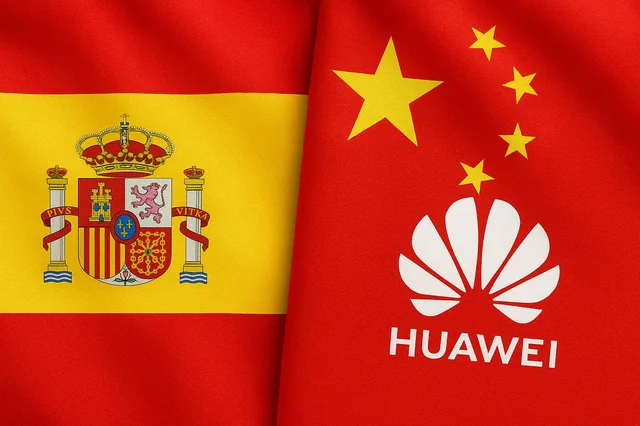
Madrid (Agencies) July 13, 2025 — The Spanish Ministry of the Interior has awarded a controversial €12.3 million contract to Chinese tech giant Huawei for the storage and management of judicially authorized police wiretaps, reigniting debate over national cybersecurity and foreign influence in critical infrastructure.

Under the agreement, Huawei will supply its OceanStor 6800 V5 enterprise-grade data storage systems to archive sensitive surveillance data collected by law enforcement and intelligence agencies. The contract was facilitated through Mitsubishi Corporation as part of Spain’s centralized procurement framework spanning 2021 to 2025.
The decision has drawn criticism from cybersecurity experts and NATO-aligned intelligence officials, who warn that Huawei’s close ties to the Chinese Communist Party pose a strategic risk. Despite widespread bans on Huawei in 5G networks and critical systems across countries like the United States, United Kingdom, Germany, and France, Spain has continued to engage the company for high-security applications.
Internal sources from the Spanish National Police and Civil Guard have expressed unease, citing concerns over potential backdoor vulnerabilities and the lack of third-party auditing in Huawei’s proprietary systems. “We are being asked to secure sensitive operations using systems that are not trusted by most of our allies,” one officer told The Objective.
Huawei has long supported Spain’s SITEL system—used for legal surveillance—and maintains that its servers are secure and inaccessible without judicial oversight. The company denies any involvement in espionage and insists that proper encryption protocols can safeguard data regardless of vendor origin.
The controversy is further compounded by political ties. Former Prime Minister José Luis Rodríguez Zapatero reportedly played a role in Huawei’s initial entry into Spain’s law enforcement infrastructure, while current Prime Minister Pedro Sánchez has adopted a more conciliatory stance toward Beijing, distinguishing himself from the EU’s harder line on Chinese tech firms.
As Huawei expands its footprint in Spain with new innovation hubs and public sector contracts, critics argue that the country’s approach undermines the European Union’s digital sovereignty agenda. The discrepancy between EU cybersecurity recommendations and Spain’s procurement practices could have lasting implications for the bloc’s collective security posture.