

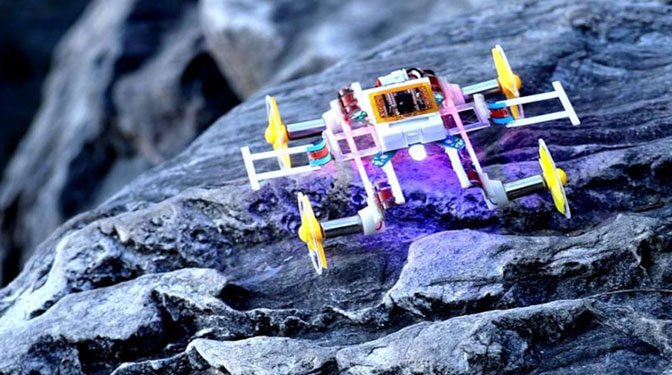
Beijing (Agencies): Chinese researchers at Tsinghua University have made a groundbreaking advancement by developing the world’s smallest and lightest untethered terrestrial-aerial microrobot capable of transforming into various shapes. The robot, measuring 9 centimeters in length and weighing only 25 grams, can operate flexibly on land and in the air with a top speed of 1.6 meters per second on the ground. This innovative microrobot is set to replace humans in performing tasks across complex and hazardous environments.
A key feature of the microrobot is its thin-film-shaped actuator, which enables continuous shape transformation and “locking” into specific configurations. The actuator, described as the “heart” of the microrobot, functions as a “morphable exoskeleton” and integrates components like sensors and motors, allowing it to adapt seamlessly to different environments. Utilizing a modular design strategy, researchers incorporated actuators, rotors, motors, control modules, and a lithium battery to create the robot.
Professor Zhang Yihui, who led the research, noted that existing small-scale actuators below five centimeters often lack the ability to morph and lock into different shapes. The newly developed actuator resolves these limitations with advanced shape morphing, locking capabilities, and wireless control, resulting in unparalleled agility for the robot.
The microrobot holds significant potential in hazardous tasks such as fault diagnosis, equipment maintenance, and geological exploration. It could replace humans in challenging scenarios and dangerous environments. Additionally, the robot’s actuator shows promise in the medical field, including deployable implantable devices like vascular stents to improve blood flow, and haptic feedback interfaces for VR and AR applications. The research team also created a “miniature Transformer actuator,” standing just 4.5 centimeters tall and weighing 0.8 grams, showcasing its versatility.
Professor Zhang emphasized the challenges of achieving such capabilities in a compact, lightweight design, calling the breakthrough a new path for miniature robotic systems. The research was published in the prestigious international journal Nature Machine Intelligence, underlining its global significance and innovative contributions to robotics and medical technology.