

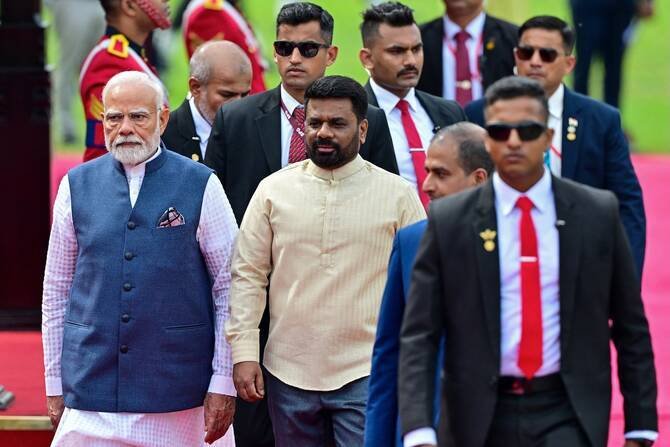
COLOMBO (Agencies): Indian Prime Minister Narendra Modi was accorded a grand welcome in Sri Lanka on Saturday, where the two nations inked several key agreements on defense, energy, and technology, reflecting deepening ties amid growing regional competition with China.
Modi’s visit marks the first by a foreign head of state since Sri Lankan President Anura Kumara Dissanayake and his leftist alliance assumed power last year. In a symbolic gesture of friendship, President Dissanayake conferred upon Modi the country’s highest civilian honor, Mithra Vibhushan, during a joint press conference in Colombo.
“This prestigious honor is conferred upon heads of states and government for their friendship, and honorable Prime Minister Modi highly deserves this honor,” said Dissanayake, after a ceremonial 19-gun salute and guard of honor held at Independence Square.
The visit resulted in the signing of seven major cooperation agreements, focusing on defense collaboration, IT sharing, and energy trade. Modi’s high-powered delegation included External Affairs Minister S. Jaishankar, National Security Adviser Ajit Doval, and Foreign Secretary Vikram Misri.
Among the most significant outcomes of the visit was a tripartite agreement between India, Sri Lanka, and the UAE to develop the strategic Trincomalee port into an energy hub. Additionally, both nations signed a Grid Inter-Connectivity Agreement to facilitate electricity exports from Sri Lanka to India and committed to building a multiproduct energy pipeline.
“We welcome the important agreements made in the area of defense cooperation. We have also agreed to work together on the Colombo Security Conclave and security cooperation in the Indian Ocean,” Modi stated.
Modi arrived in Colombo after attending the BIMSTEC summit in Thailand. His visit underlines New Delhi’s intent to deepen ties with Sri Lanka amid growing Chinese influence in the region. China remains Sri Lanka’s largest lender and a key investor, particularly in infrastructure, prompting Colombo to maintain a delicate diplomatic balance.
President Dissanayake’s earlier visits to New Delhi in December and Beijing in January signal Sri Lanka’s strategic positioning between two regional giants.
“Within the Indian subcontinent and Chinese belt, Sri Lanka is caught as a strategic island — not only in the Indian Ocean — between these two giants,” said Dr. B.A. Hussainmiya, a historian and geopolitical analyst. “Sri Lanka, being a very small country, cannot hold its strength unless it creates a balanced and nuanced diplomatic approach between these two powers to keep it afloat in the system.”
The agreements signed during Modi’s visit are expected to pave the way for long-term collaboration in the Indian Ocean region, enhancing both economic and security partnerships.